Our Content Hub just got a superpower: JSON!
If you have ever used an API, you have likely encountered JSON. In layman's terms, it is a structured text string that machines love to read. But for the rest of us, it is about to become the hidden superpower in your document workflow.
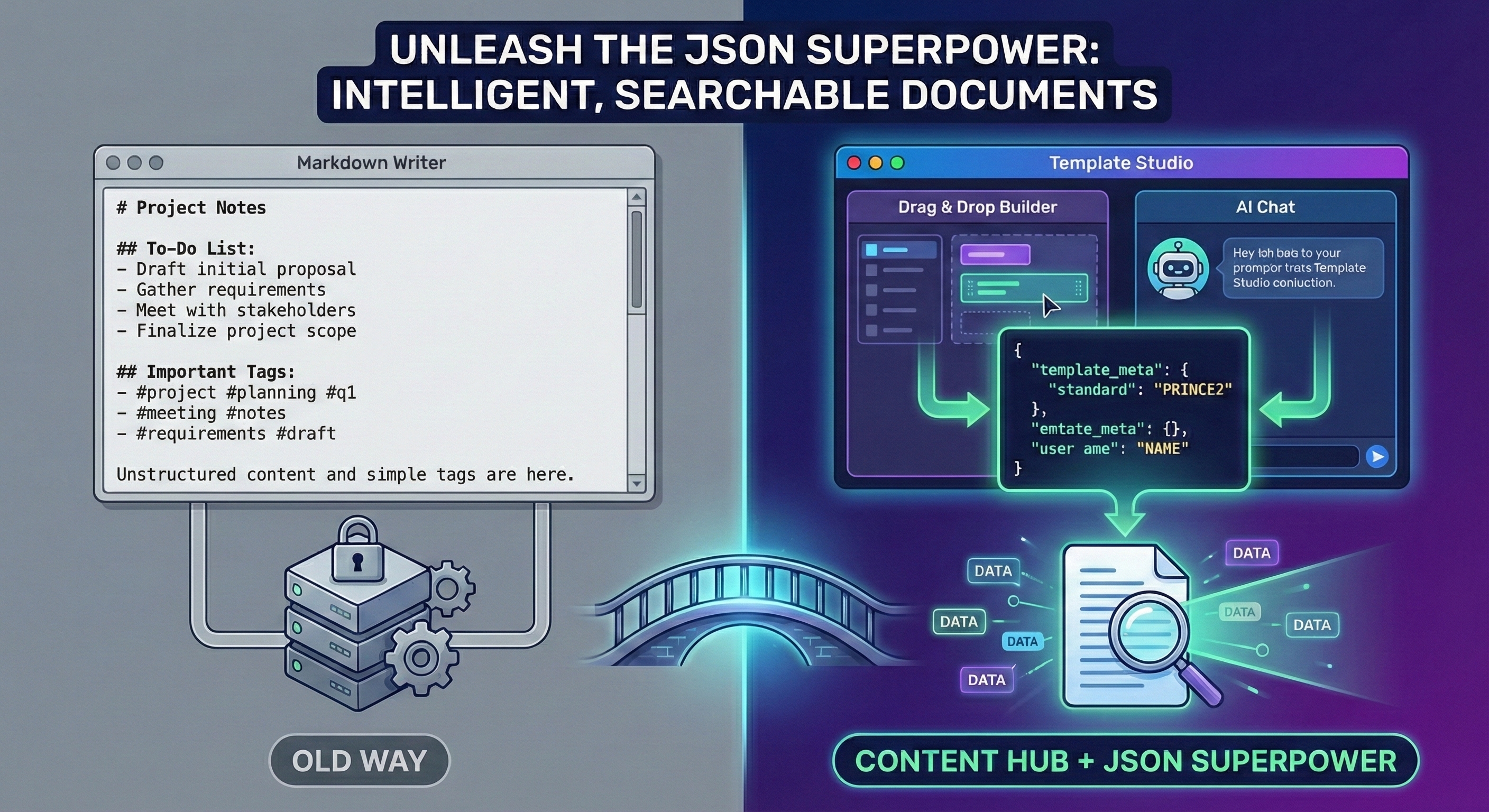
We are excited to announce a major upgrade to our Content Hub. We have replaced the standard "Markdown Writer" with our new Template Studio—and underneath the hood, it runs entirely on JSON.
From Writer to Studio: How It Works
The Template Studio is an interface designed to set up document templates where the output is a precise JSON schema. We wanted to make this powerful technology accessible to everyone, so we built two distinct ways to create your templates:
-
No-Code Drag & Drop: Visually build your structure by dragging fields into place.
-
AI-Powered Chat: simply describe what you need in natural language, and let our AI generate the schema for you.
Once your template is defined, the Studio outputs a JSON Schema. This schema is instantly ready to be picked up by AI Agents and the Document Writer, ensuring every document created follows a standardized, intelligent structure.
The Problem with Rigid Databases
To understand why this is a big deal, we have to look at how data is traditionally stored. Standard databases are powerful, but they are rigid. They demand a predefined schema.
If you have ever needed to add a new data point to a project, you know the headache: you usually have to alter the database schema, perform migrations, or ask a developer to add a column. This rigidity becomes a bottleneck when your information needs evolve.
JSON liberates you from this constraint.
By using JSON in the Content Hub, we allow for dynamic, schema-less structures. You can add new fields, objects, or arrays to your document templates whenever necessary without disrupting existing structures or touching the main database.
The Superpower: Embedded, Searchable Metadata
The true benefit of this update is that you can now embed searchable metadata inside the text you are making.
This means every document carries its own context, tags, and organizational logic. You are effectively storing rich, structured data within a single field. It turns every document into a self-describing entity.
Imagine a document library where you can search not just by file name, but by intricate details embedded deep within the structure—querying specific attributes, nested values, or arrays.
Here is what that looks like in practice. Below is an example of a JSON schema for a PRINCE2 report. Notice how the data isn't just text; it is categorized by "cause," "consequences," and "recommendations."
JSON
{
  "template_meta": { "standard": "PRINCE2", "type": "Report" },
  "sections": [
    {
      "id": "cause",
      "title": "Cause of Exception",
      "fields": [
        { "key": "cause_desc", "label": "Description of Cause", "type": "textarea" },
        { "key": "consequences", "label": "Consequences if not addressed", "type": "textarea" }
      ]
    },
    {
      "id": "options",
      "title": "Options",
      "fields": [
        { "key": "options_analysis", "label": "Available Options", "type": "textarea", "help_text": "Detail the different ways forward." },
        { "key": "recommendation", "label": "Recommendation", "type": "textarea" }
      ]
    }
  ]
}
Why This is the Future
This isn't just about storing data; it’s about making data actionable.
By embedding this structure directly into the document:
-
Compliance is simplified: Required fields are baked into the template.
-
Search is granular: Find exactly what you need, even in massive libraries.
-
Agility is increased: Change templates on the fly without database migrations.
In essence, JSON is not just a data format; it is a philosophy for smarter, more agile document management. It provides the tools to create living, breathing documents that carry their own intelligence.
The hidden superpower of JSON is ready to be unleashed in your workflow. Are you ready to harness its potential?