In almost every organization, from agile startups to global enterprises, a silet productivity killer lurks: the local spreadsheet. We have all seen it - a critical project log, product specification or customer quote living in a file named "Version 4_FINAL_updated" on a single employee's computer.
The reason is simple: ease of use. Spreadsheets are intuitive and flexible. However, they lack the core capability required for a modern, AI-driven business: synchronicity. When data exists as a discrete instance rather than a shared asset, the "single source of truth" (SSOT) dissolves. Recent industry data suggests that data transformation challenges, specifically the gap between technical storage and user accessibility, remain one of the largest hurdles in modern digital transformation.
To build a foundation for artificial intelligence, we must bridge the gap between the user's need for flecibility and the organization's need for centralized, queryable data.
The traditional barrier: databases vs humans
The solution to data integrity has existed for decades: the relational database. By centralizing information, we ensure that a product specification remains consistent regardless of who accesses it.
However, relational databases have historically suffered from a massive "UX tax". Interacting with them directly requires and understanding of SQL or complex query languages. To bypass this companies often invest in expensive SaaS platforms. Unfortunately these are frequently "one size fits all" solutions that are rigid, costly, and solve only one niche problem at a time. This leaves users retreating back to the comfort of their local excel files, recreating the very silos we aim to destroy.
The "Vibe Coding" revolution: democratizing the interface
The landscape has shifted with the emergence of "Vibe Coding". This is not just a trend: it is being recognized as the new literacy for the AI-native software generation. We are entering and era where the interface (front end) is no longer a permanent, high-cost development project.
Using natural language, users can now generate custom interfaces to interact with a database in seconds.
Vibe coding solves the accessibility problem of the database. It allows the data to remain centralized and "true" while giving the user the specific, flexible experience they require to stay productive.
Making data AI-ready: the Brage AI framework
Once your data is centralized and accessible, the next challenge is making it available for AI in a form AI or large language models understand. At Brage AI we utilize the Model Context Protocol or MCP to route requests through three distinct recovery approaches. This ensures that the AI is not just guessing, but accessing the right data in the right way.
The MCP is developed as an open standard acting as a "universal translator" or router between AI models and their data sources. The user or agent asks via natural language and the MCP handles the rest.
The retrieval is done in the following three ways depending on the question asked and the requirements of the agent or user (agent being an autonomous AI agent executing tasks on their own such as a "Project Support Agent" writing a report on a project)
RAG (Retrieval Augmented Generation)
RAG is the standard for connecting AI to large, continuously updated knowledge basees. It is excellent for finding specific information in vast document sets. However, RAG has inherent limitations. Research indicates that RAG struggle with quantitative analysis such as "how many" or "when" types of questions because it is designed for semantic search rather than data aggregation
CAG (Cache Augmented Generation)
CAG is the specialized framework utilized by environments like Microsoft Copilot, Google Gemini. It involves loading a specific set of documents directly into the AI's active memory for the duration of the interaction. This may sound great but there are limitations: the memory is limited setting a cap on how much knowledge (you can't add everything). It is also token intensive increasing AI costs. And, if the data is frequently updated this adds complexity and compute resource needs.
The Brage AI approach: we use "CAG on demand". For example, a project management agent will have every relevant document for that specific project in its cache updated daily. This ensures the AI agent has 100% context for specific initiatives without hitting context window limits for the entire company database. Select datasets are automatically routed to the relevant agents.
The Query (SQL agents)
The final piece is the "Query" approach. This involves an agent that speaks database languages like SQL fluently. When you ask; "How many projects are currently over budget?" or "What was the total spend for Client X last year?", the AI doesn't just search for a document - it queries the relational database directly to provide and exact, data-driven answer
Conclusion: A Plug-and-Play future
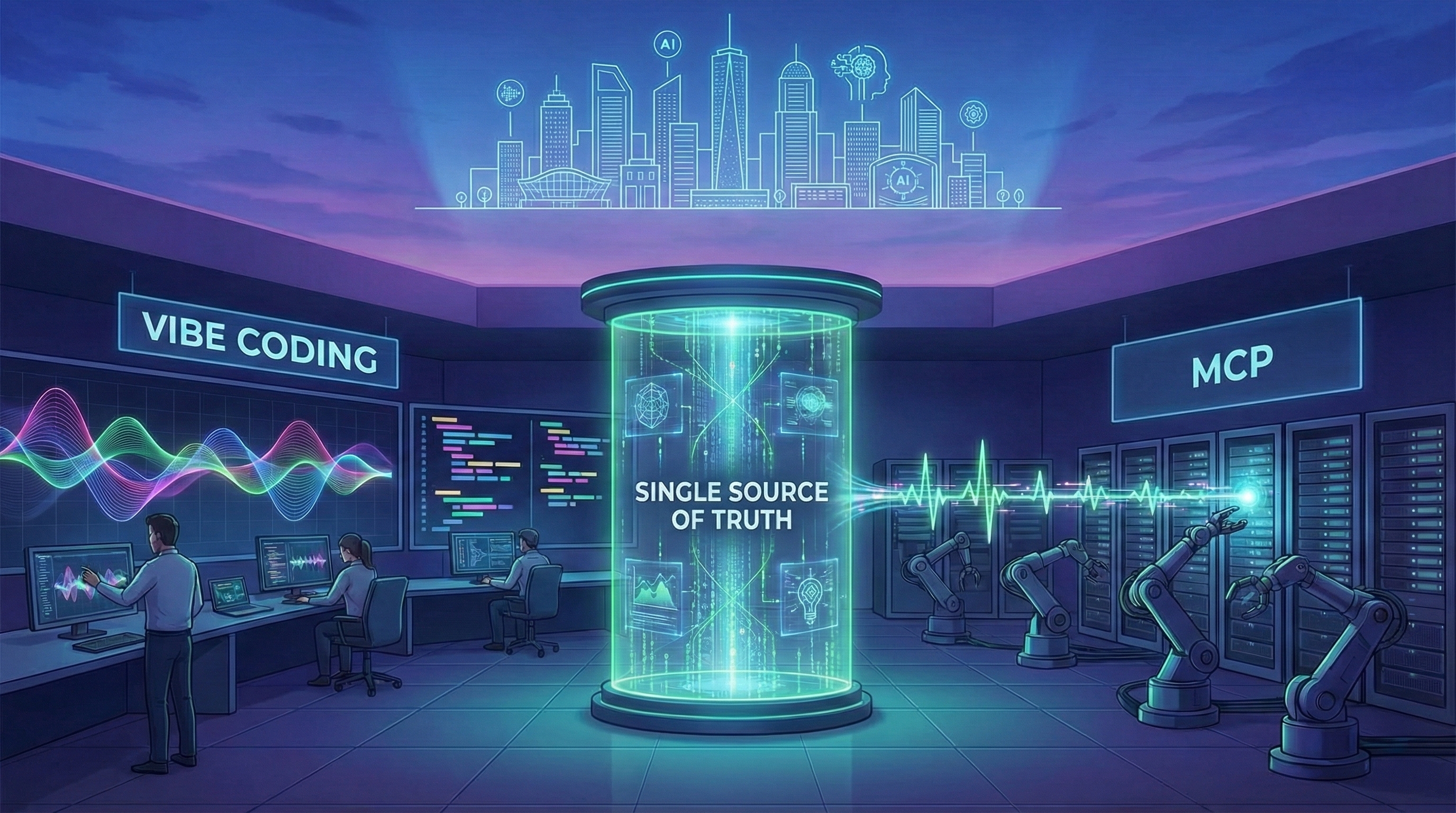
Achieving a Single Source of Truth is no longer just about data hygiene; it is a prerequisite for functional AI. By combining the power of Postgres SQL and Vector Databases with the flexibility of Vibe Coding and MCP connectors, we can finally move past the era of disconnected spreadsheets.
The result is a working knowledge hub that is human-friendly, AI-ready, and inherently scalable. Organization that bridge this gap will be the ones that lead the AI-intergrated economy of tomorrow.
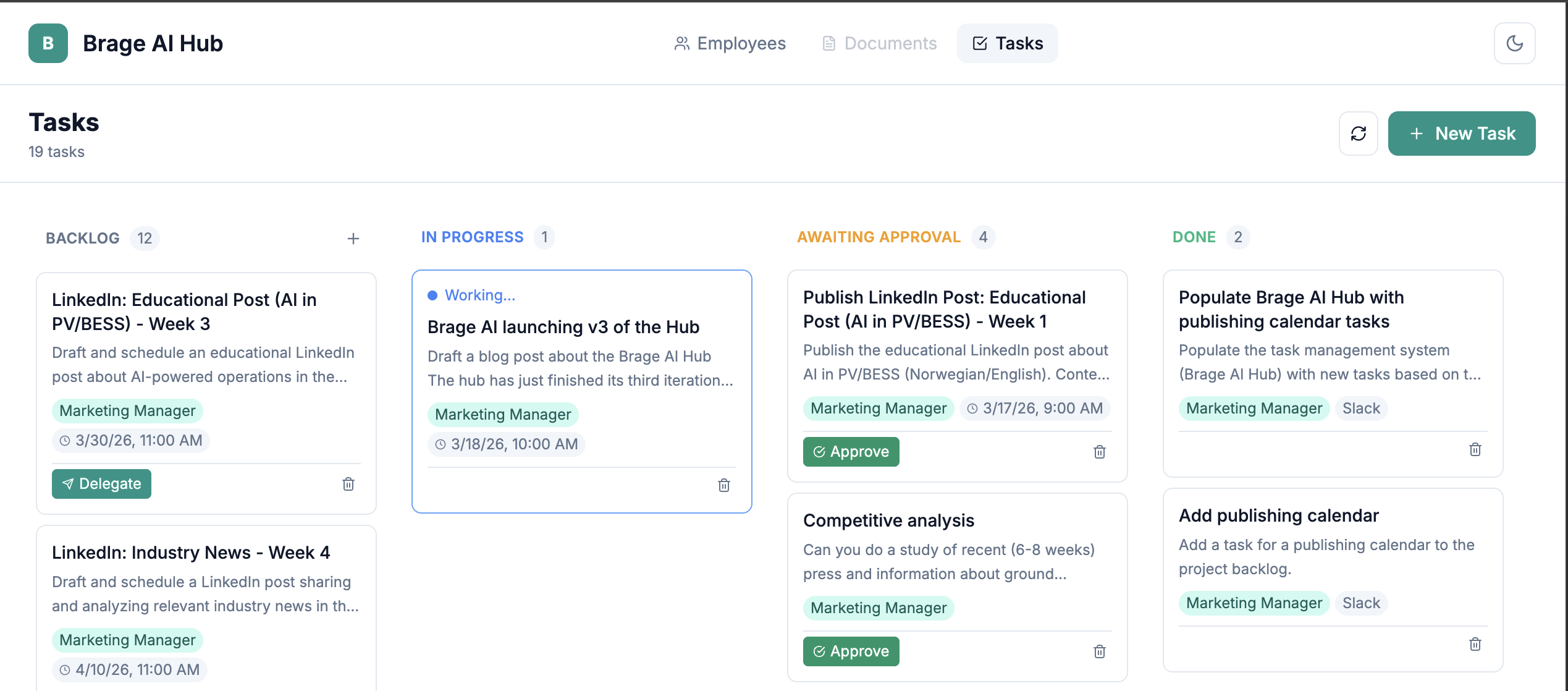
The solution is made with Antigravity and hosted on Cloud Run. Deployment automated with Github actions - all set up via Antigravity (using Github and Cloud Run MCP servers)
Sources: